
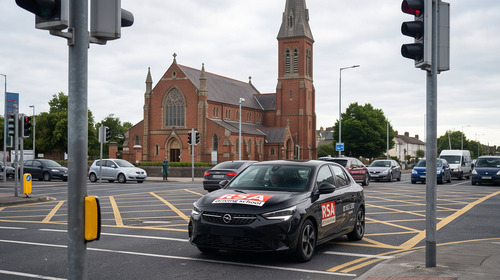
You are not the first learner to sit in a car outside your house in Tallaght with your hands already sweating before the engine even starts. Nerves show up for teenagers, for parents fitting lessons around the school run, and for people starting to drive later in life who feel they should already know this by now. None of that means you cannot learn. It means your nervous system is doing exactly what it is designed to do around something new and slightly risky.
Nerves behind the wheel usually come from one of a few places. Maybe you have never been in control of a car before, only ever a passenger. Maybe a bad experience, a near miss, a snap at you from someone in the passenger seat, left a mark. Maybe you simply do not like feeling watched or judged, and a driving lesson can feel like both at once. None of these reasons are silly. They are the actual, ordinary causes of test anxiety and driving nerves, and naming them tends to loosen their grip a little.
Why familiar roads make such a difference
Anxiety feeds on the unknown. If every lesson throws a new junction, a new hill start, and a new roundabout at you in the same hour, your brain never gets the chance to relax into any one skill. That is why we tend to keep early lessons close to roads you already half know: the quieter stretches around Kiltipper, the residential loops near Fettercairn, the gentler junctions before Belgard Road gets busy. Driving somewhere familiar frees up mental space for the actual skill, instead of spending all of it just coping with newness.
Once basic control, steering, clutch control if you are learning manual, mirror checks, feels less like juggling and more like habit, we start layering in the trickier stuff. That might mean one of the busier junctions near the Square, or a roundabout on Belgard Road at a quieter time of day before trying it at rush hour. The point is never to throw you in and see what happens. It is to build up gradually enough that each new challenge feels like a small step rather than a leap.
What a patient instructor actually does differently
Patience is not just a nice personality trait, it is a teaching method. A patient instructor will explain the same thing three different ways if the first two did not land. They will notice when your shoulders are up around your ears and suggest pulling in for a minute rather than pushing on. They will not sigh, glance at the clock, or make you feel like a burden for needing something repeated. If a lesson goes badly, they will talk through what happened calmly afterward instead of leaving you to stew on it.
This matters more for anxious learners than for confident ones, because fear has a way of making mistakes feel bigger than they are. A stall at the lights on Airton Road feels like the end of the world in the moment. A patient instructor treats it as exactly what it is: a small, fixable thing that almost every learner does at some stage.
Building confidence lesson by lesson
Confidence rarely arrives in one dramatic breakthrough. It builds in small, almost boring increments. The first time you manage a hill start without stalling. The first time you check your mirrors without being reminded. The first time you sit at a junction near the Square and judge the gap correctly on your own. None of these feel huge on the day. Stacked together over weeks, they are the whole of what confidence actually is.
It helps to notice these small wins out loud rather than only focusing on what went wrong. Ask your instructor to point them out too. Anxious learners often remember every mistake in sharp detail and forget the steady progress happening underneath it.
Getting ready for the test itself
Because so many Tallaght learners test at the centre off Broomhill Road, it makes sense to spend real time on the roads that feed into it before test day arrives. Familiar roundabouts, junctions you have driven a dozen times, and a route that no longer feels like a mystery all take a good chunk of the fear out of the day. The nervous system calms down around things it recognises.
For the official pass mark, test format, and any current waiting times, always check rsa.ie directly rather than relying on what you have heard secondhand. That is the one part of this we would rather you get from the source than from us.
Being a nervous learner is not a flaw to apologise for. It is simply where you are starting from, and starting is the whole point.
Are you test-ready?
Six honest questions. Tick what's true today. We'll tell you where you stand.
Questions, answered
I get shaky and sweaty before every lesson, is that normal? +
Yes, and it is more common than most learners admit. Physical nerves, a racing heart, sweaty palms, tend to ease once you are actually moving and concentrating on the road. Tell your instructor honestly how you feel before you set off. A good instructor will adjust the plan for that day rather than push through.
Can I ask to avoid the Belgard Road roundabouts until I feel ready? +
Of course. There is no rule that says lesson three has to include the busiest junctions in Tallaght. A patient instructor will start you on quieter residential roads around places like Kiltipper or Fettercairn and only bring you toward Belgard Road once your basic control is solid.
Will I have to do my test at the centre off Broomhill Road? +
Most learners based in Tallaght sit their test at the centre off Broomhill Road, yes. Because you will likely train on those same approach roads for weeks beforehand, the area tends to feel familiar rather than frightening by test day.
What if I have failed my test before and I am dreading trying again? +
A previous test that did not go well says nothing about whether you can drive safely, it often just means nerves got the better of you on the day. Tell your instructor what happened last time. Going over the exact routes and junctions near Broomhill Road again, calmly, is usually the most useful thing you can do before booking another attempt.
See if we've got an instructor in your area
Check availability and get local lesson pricing near you in Tallaght and South West Dublin.
Got a question?
Ask our AI assistant about lessons. Please keep payment details out of chat.