
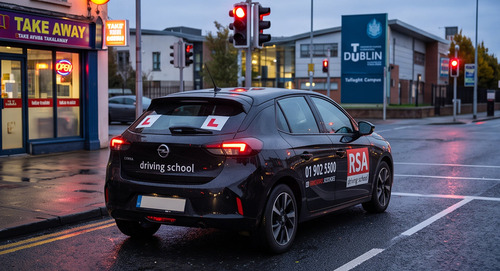
You are not too old to learn. That sentence needs saying because so many people quietly believe the opposite. If you have been putting it off for years, wondering whether 35 or 45 is somehow too late to start, it is worth looking at how we actually approach lessons for adult learners before you talk yourself out of it again.
Here is the truth: a good chunk of the learners we teach in Tallaght are not teenagers. They are parents dropping kids to school on the Greenhills Road who are tired of relying on lifts. They are people who moved out from town and found that Tallaght without a car is a much smaller place. They are workers whose new job near Belgard Road needs a licence they never got around to getting. Thirty, forty, fifty, it does not matter. The car does not know your age.
What is genuinely different
It would be dishonest to say nothing changes with age, because something does. It is rarely the physical side. Reaction times, coordination, judgement, all of that holds up fine for the vast majority of adults well into later life. What changes is habit and nerve.
A seventeen year old has no fixed way of moving through the world yet. Everything is new, so a roundabout is just another new thing. An adult learner has spent twenty or thirty years walking, cycling, or sitting in the passenger seat forming opinions about how traffic behaves. Some of those instincts help. Some get in the way. Unlearning a habit takes longer than learning a fresh one, and that is the real adjustment, not age itself.
Nerves show up differently too. A younger learner is often nervous about being watched. An older learner is often nervous about looking foolish in front of people younger than them, or about wasting money if it takes longer than expected. That pressure is self imposed, and it is almost always harder on you than the actual driving is.
Why age is rarely the real obstacle
The obstacle is usually confidence, not capability. Adults tend to judge themselves far more harshly than a driving instructor ever would. You stall at the junction near the Square and you feel it as proof you are somehow behind. A seventeen year old stalls in the same spot and forgets about it in ten minutes.
We would gently push back on the idea that this is a race against a clock. It is not. There is no version of this where arriving at competence at 42 counts for less than arriving at 19. The test does not ask your age. It asks whether you can control a car safely, read the road, and make sound decisions at a roundabout or a junction. Those things are built through practice, not youth.
What actually helps
Consistency helps more than intensity. One lesson a week, every week, tends to build steadier skills than cramming several lessons into one weekend and then leaving a gap for a month. Habits, good ones this time, need repetition spaced out over weeks, not squeezed into days.
Familiar roads help too. Practising near where you actually live and drive day to day, whether that is around Fortunestown, Aylesbury, or the junctions off the N81, means the skills you build are the ones you will use. There is no substitute for handling a real roundabout during a real Tuesday rush rather than an imagined one in a manual.
Naming the nerves helps as well. If you are anxious, say it to your instructor. A good instructor adjusts the pace, explains more, and lets you sit with a manoeuvre longer if that is what you need. There is no prize for pretending confidence you do not feel yet.
The honest bit
It will take the time it takes. Some adults learn faster than a lot of teenagers because they have better focus and less to prove to anyone else in the car. Some take a bit longer because old habits are stubborn. Neither is a verdict on you. It is just how learning works at any age.
If you are thinking about starting at 30, 40, or later, the honest answer is: start. The road does not check your date of birth. It checks whether you are paying attention, and whether you are willing to practise until the car feels less like a puzzle and more like an extension of you moving through Tallaght, one junction at a time.
Are you test-ready?
Six honest questions. Tick what's true today. We'll tell you where you stand.
Questions, answered
Is it harder to learn to drive at 40 than at 20? +
Not really harder, just different. Older learners often overthink small mistakes that a teenager would shrug off. The skills come the same way for everyone: practice, repetition, and time behind the wheel around real junctions like the ones on Belgard Road.
Will I be the oldest person taking lessons in Tallaght? +
Almost certainly not. We teach people in their 30s, 40s, and 50s regularly, including parents learning alongside their own teenagers. It is one of the most common reasons people come to us.
Where will I actually learn to drive around Tallaght? +
We build lessons around the roads you will actually use and eventually be tested on, including the roundabouts near Belgard Road, the N81 approach roads, and quieter estates around Fortunestown and Aylesbury before moving to busier routes.
How do I book my test once I feel ready? +
Your instructor will help you judge when you are ready, but booking itself goes through the RSA. Check rsa.ie for the test centre off Broomhill Road, current waiting times, and what to bring on the day.
See if we've got an instructor in your area
Check availability and get local lesson pricing near you in Tallaght and South West Dublin.
Got a question?
Ask our AI assistant about lessons. Please keep payment details out of chat.