
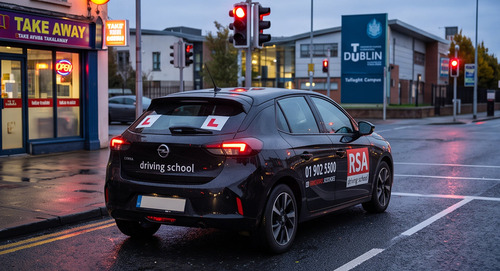
The first thing everyone asks about is the missing pedal. There is no clutch in an automatic, so your left foot has nothing to do and just rests on the floor. It feels odd for about ten minutes and then you stop noticing it. If you are still deciding which way to go, it helps to read up on the practical differences before you book anything, and we cover that in more detail in our piece on automatic versus manual and which to learn in.
Your right foot does everything now. Brake and accelerator, same foot, same as it always would have been for braking anyway. The gearstick has a few letters instead of numbers: P for park, R for reverse, N for neutral, D for drive. You put it in D and mostly leave it there. No clutch control, no biting point, no stalling at the lights on the Square. That part of driving, the part that used to eat up half a learner's concentration, just isn't there anymore.
The creep catches people out
Take your foot off the brake in an automatic and the car rolls forward on its own, even with no pressure on the accelerator. That is the creep, and it surprises almost every first timer. You expect the car to sit still like a manual in neutral, and instead it edges ahead like it has somewhere to be. It is useful once you trust it. Rolling up to a junction on Greenhills Road, you can control your speed with the brake alone and let the creep do the crawling forward. No need to balance clutch and gas at the same time. Your foot goes from brake to gas and back, and that is the whole job.
Some learners find the creep unsettling on a hill. Stopped facing up an incline near the Square, the car won't roll back the way a manual might without careful clutch work. It holds itself, more or less, and the creep even pushes gently forward once you ease off the brake. It takes trust to let go of old habits, especially if you've watched someone struggle with hill starts in a manual. There is genuinely less to manage here, not more.
What actually changes in your head
Take away the gear changes and you get a strange, welcome side effect: spare attention. All the mental space that used to go on when to change up, when to change down, whether you're in the right gear for a roundabout, is suddenly free for other things. And there is plenty else to think about on the roads around here.
Take the roundabouts near Belgard Road. In a manual, you are juggling gear choice, clutch, mirrors and lane position all at once, especially with the retail park traffic feeding in and out. In an automatic, the gear box is sorted, so you can give full attention to which lane you need, when to signal, and what the car beside you is actually doing. Same goes for the junctions along the N81, where traffic can bunch up fast and you need to read the situation quickly rather than manage your feet.
This does not mean automatic driving asks less of you as a learner. You still need to judge gaps, read signs, check mirrors properly and position the car well. What changes is where your effort goes. Instead of splitting concentration between the mechanics of moving the car and the road around you, nearly all of it goes to the road. For a lot of people, especially those who found gear changes stressful before, that shift makes the first few lessons feel far less overwhelming.
What your first lesson actually looks like
We usually start somewhere quiet, away from heavy traffic, so you can get used to the brake and accelerator without pressure. You'll practice moving off, stopping smoothly, and getting a feel for the creep before we go anywhere near a junction. Braking gently instead of stamping is the main skill to pick up early, since the pedal does more work than you expect.
Once that feels natural, we move toward busier roads. Somewhere like the streets around Tallaght village give you real junctions and real decisions without throwing you straight into heavier traffic. From there it is a short step to Belgard Road and the roundabouts nearby, where the benefit of not thinking about gears becomes obvious.
If you are heading for a test at the centre off Broomhill Road, none of the routes change based on car type. What changes is how much of your attention is free to actually drive well. Check rsa.ie for anything specific about test requirements and fees, since those details are best confirmed at the source rather than guessed at here.
Automatic or manual for you?
Four quick questions. There's no wrong answer, just the one that fits your life.
Questions, answered
Is it harder to find automatic lessons in Tallaght than manual ones? +
It used to be trickier, but automatic instruction has become common enough that most schools in the area, including ours, can put you in an automatic car without a long wait. Worth asking when you book, since instructor cars do get scheduled out.
Will an automatic licence let me drive a manual car later? +
No. If you test and pass in an automatic, your licence is restricted to automatic cars only. If you think you might want to drive a manual down the line, mention that early on so we can talk through what suits you before you commit to lessons.
Are the test routes from the Tallaght test centre any different for automatics? +
The routes themselves are the same for everyone booked through the centre off Broomhill Road. What changes is what you are dealing with mentally: no clutch control to think about, so you can focus fully on observation and positioning, which suits a lot of nervous learners.
Where do you usually start an automatic learner in Tallaght? +
We tend to start on quieter roads around the Square before moving out toward Belgard Road and the roundabouts near the N81, once the pedal work feels natural. No point throwing you into heavy junctions before you trust the car to creep and stop the way you expect.
See if we've got an instructor in your area
Check availability and get local lesson pricing near you in Tallaght and South West Dublin.
Got a question?
Ask our AI assistant about lessons. Please keep payment details out of chat.